how many heretics?

How many laypersons in the Church today are heretics?
How many religious or priests in the Church today are heretics?
How many Bishops in the Church today are heretics?

It’s important to distinguish between mere material heresy and formal heresy. Material heresy occurs whenever a person believes, asserts, or teaches a doctrinal error that meets certain conditions. To be material heresy, an idea must pertain to an important matter of faith, morals, or salvation. The idea must either have been taught infallibly by the Magisterium, in any of the three ways that the Magisterium teaches infallibly, OR it must be an idea clearly and definitively taught by Tradition or Scripture.

However, the heretic does not deny all important truths of faith, morals, and salvation. An apostate is someone who rejects the Faith in its entirety. A heretic always denies something substantial of the Faith, but also always retains something substantial of the Faith. Protestantism is material heresy; all Protestants (knowledgeable adults, at least) are material heretics. If a Catholic converts to Protestantism, he has converted into heresy. But if any Christian were to convert to Judaism or Islam, he would be an apostate, not a heretic. For he has rejected so many important truths of the Christian Faith that it cannot stand.

[1 Corinthians]
{15:17} But if Christ has not risen, then your faith is vain; for you would still be in your sins.

If anyone believes that Christ has not risen, or that Christ is not God Incarnate, then the entire Faith is vain; it cannot stand. Therefore, such a belief is apostasy as well as heresy.

Formal heresy is an actual sin. A person commits formal heresy by knowingly choosing to adhere to material heresy. When the knowledge and choice are both full, then the act of formal heresy is an actual mortal sin. However, any act of formal heresy is objectively a mortal sin.

Very many Catholics in the Church today are in a state of material heresy. They obstinately deny or obstinately doubt the definitive teaching of the Magisterium on matters of morals: that direct abortion is always gravely immoral, that contraception is always gravely immoral, that premarital sex is always gravely immoral, that Tradition and Scripture are infallible, that the Magisterium can teach infallibly and require the faithful to adhere to those teachings, that Christ is present in the Eucharist in body, blood, soul, and Divinity, and many other teachings. It is difficult to say how many Catholics who adhere to material heresy do so with a knowing choice, such that they are committing the objective mortal sin of formal heresy. But the number is not small.

Many priests and religious have also fallen into material heresy, and again a substantial number of these are also committing formal heresy, though it is difficult to perceive how many.

Even a number of Bishops have fallen into material heresy. For example, at the 2008 Bishops’ Synod on Scripture, the Bishops could not obtain a sufficient number of votes to assert that Sacred Scripture is entirely inspired and entirely infallible. Their working document contained the heretical claim:

“In summary, the following can be said with certainty … with regards to what might be inspired in the many parts of Sacred Scripture, inerrancy applies only to “that truth which God wanted put into sacred writings for the sake of salvation” (DV 11)….” (INSTRUMENTUM LABORIS, n. 15, c)

But the final document dropped that heretical assertion, but also failed to make any statement of believe in total inerrancy and total infallibility. Both are the infallible teaching of the Magisterium. But so many Bishops have rejected this infallible teaching, thereby falling into material heresy, that they were unable to teach on the subject at all. In place of 15.c. quote above, this suggestion was substituted:

“The synod proposes that the Congregation for the Doctrine of the Faith clarify the concepts of inspiration and truth of the Bible, as well as the relationship between them, so as to better understand the teaching of Dei Verbum 11.” (Chapter 1, proposition 12, Inspiration and Truth)

And there are other matters of faith and morals from which certain Bishops have strayed. A recent controversy in South American about a direct abortion of twins given to a young girl at a Catholic hospital, and a more recent direct abortion given to a woman at a Catholic hospital in Phoenix, Arizona, revealed that even the Magisterium’s teaching against direct abortion is not adhered to by all Cardinals, Bishops, priests, and religious.

It is difficult to say how many Bishops, priests, and religious have fallen into material heresy, but the problem is certainly serious.

Posted in heresies, Scripture | Comments Off on how many heretics?

false argument: the transparent proxy

Another common false argument today, I call the ‘transparent proxy’ argument. A person argues a particular point of view based on the claim that he is merely presenting the views of someone else: a Saint, a Pope, a priest or theologian, or even the Church Herself. The person admits no role of his own, other than explaining the position of another, and he admits no possibility of interpretation or misunderstanding, in effect claiming to be a proxy for another. The person claims to be transparent, i.e. to have no effect on the meaning of what is being presented. This argument is false because no proof is presented that the person’s explanation is accurate. Often it is the case that the person has introduced substantial distortions or new ideas into the work of the other person.

Examples:

Christopher West represents his teaching on theology of the body as if he were merely explaining what Pope John Paul II taught. Yet many of his critics have pointed out substantial differences between his work and that of the late holy Pope. A sincere reading of both author’s works, in my opinion, reveals little similarity between the two.

Jimmy Akin claims that his ideas on salvation and predestination are not the errors of Calvinism but the position of St. Thomas. His commentary on Calvinism (A Tiptoe through TULIP) repeatedly claims that he is merely presenting the ideas of Augustine, Molina, and especially Aquinas. He does not admit that he is offering a relatively unique (and in my view erroneous) position on salvation.

I’ve had discussions with a number of different fellow Catholics on various topics in speculative theology (i.e. on open questions about which the Magisterium has no definitive teaching). It is not uncommon for the person to claim that he or she is merely presenting the teaching of the Church, without any interpretation or opinion, even when no definitive teaching of the Magisterium on the topic can be quoted. Instead of saying, I believe that… or my understanding is… , the person claims ‘Holy Mother Church teaches this, and not that’. Such an assertion would be fine if it were supported by a theological argument, or at least by citations or quotes from magisterial documents. But often it is not. Instead, the person goes on to explain at length what the Church supposedly teaches, admitting no role for his or her own interpretation and opinion, admitting no possibility of error on his part.

The fundamentalist Protestant says that Sacred Scripture is infallible and I agree. But then he gives an interpretation of a passage and I disagree. The common reply from a fundamentalist in such a case is to claim that my disagreement is merely an erroneous opinion or interpretation. But if I say, ‘What is your interpretation?’ his reply is that he has no interpretations or opinions; he is merely presenting the teaching of Sacred Scripture, and Sacred Scripture is infallible. The fundamentalist thereby makes himself out to be infallible, since he admits no possibility for misinterpretation (or any interpretation at all) on his own part.

In truth, no sinner is a transparent proxy. There is always the possibility for misunderstanding, misinterpretation, misapplication, or the introduction of new ideas. If you wish to claim that you are correctly presenting the ideas of another, you must support that claim with a sound argument. The mere claim (ipse dixit) that you are presenting the views of another cannot stand on its own.

I’ve learned that it is usually useless to argue with such persons. I offer my theological opinion, they claim that their position is correct and mine is erroneous because they are merely presenting the ideas of a Saint or Pope, or of the Church. When asked for an argument to prove such a claim, what is usually provided is merely an explanation of what is supposedly the other person’s position. Quotes might be presented, but then they are explained with a rather heavy interpretation, leaving the proxy still not transparent.

Posted in arguments | Comments Off on false argument: the transparent proxy

false argument: one Saint alone

The solus unus sanctus argument claims that a particular idea is either the teaching of the Church, or is at least a tenable theological position, solely because one Saint asserted the idea. This argument is not valid; the conclusion does not follow from the premise. The teachings of the Catholic Faith are found in Tradition, Scripture, Magisterium. The words of the Fathers, Doctors, and Saints of the Church are often a reliable indication of the teachings of Sacred Tradition, and a reliable interpretation of the teachings of Scripture and Magisterium. But their words are not Tradition or Scripture or Magisterium itself (except for those Fathers, Doctors, or Saints whose words were also an act of the Magisterium), and are not infallible.

As time passes, the Church grows in knowledge of the teachings found explicitly and implicitly in Sacred Tradition and Sacred Scripture. The Magisterium continues to answer questions on matters of faith, morals, and salvation, and to define new doctrines. Even the holiest of Saints cannot be expected to anticipate the future teaching of the Magisterium, hundreds of years in advance. So while a great theologian like Augustine or Aquinas might contribute substantially to the development of a particular doctrine, his words cannot be treated the same as a definitive magisterial teaching on the same subject.

It is an error to follow the opinion of only one Saint, while at the same time ignoring all other teachings in Tradition, Scripture, Magisterium. A person who does so sins by ignoring the teachings of the Church and by substituting the teachings of one Saint for all the teachings of Tradition, Scripture, Magisterium.

Posted in arguments | Comments Off on false argument: one Saint alone

Women should be silent in the churches

[1 Corinthians]
{14:34} Women should be silent in the churches. For it is not permitted for them to speak; but instead, they should be subordinate, as the law also says.
{14:35} And if they want to learn anything, let them ask their husbands at home. For it is disgraceful for a woman to speak in church.
{14:36} So now, did the Word of God proceed from you? Or was it sent to you alone?
{14:37} If anyone seems to be a prophet or a spiritual person, he should understand these things which I am writing to you, that these things are the commandments of the Lord.

This passage is the teaching of the Holy Spirit, not some error or bias by Paul. These things are the commandments of the Lord, found in both the Old and New Testaments.

However, Paul is not saying that women cannot speak at all in church. Earlier in this same Epistle (1 Cor 11:4-5) Paul considers that women and men might each pray or prophesy.

Instead, this silence is literal, to one extent, and figurative, to another extent. It is literal in the sense that certain roles in the Church involve one person speaking while the rest are silent. A priest at Mass often speaks alone, taking a certain role not given to women or to non-ordained men. This speaking versus silence indicates that the priest has a different role.

But this silence is also figurative, since women certainly can speak in prayer and in their participation in the Mass, when the faithful present take their proper role in the celebration. So the silence of women figuratively indicates that women are given different roles than men in the Church.

This passage also mentions the differences in roles for men and women intended by God for the family. The wife is subordinate to her husband in her role in the family, since he is the head of his wife. The roles of women in the Church are not unrelated to their roles in the family. We should be members of the Church not merely as individuals, but as whole families. The Church is a type of family, and so the difference in roles in the family also apply, to some extent to the Church.

Those persons who envision women having the same roles as men in the Church, the family, and society cannot explain why women cannot be priests. It is an anomaly to them. So even if they accept that women cannot be priests, it does not make sense to them. But those persons who understand that God gave different roles to men and women in His plan for humanity can more easily accept and understand why women cannot be priests.

Posted in Mass | Comments Off on Women should be silent in the churches

The Infiniteness of Love

True spiritual love of God and neighbor only occurs in cooperation with the supernatural grace of God. True spiritual love of God and neighbor, by finite created persons, has an infiniteness. For true love knows no bounds. And true love of any human person includes, at least implicitly, the true love of God, who is infinite.

Therefore, the true spiritual love of God and neighbor deserves an unending reward in Heaven. That reward is finite, in the sense that the finite created person only receives so much reward and no more, in accord with the Justice and Mercy of God. But that reward is also infinite, in that it never ends.

Therefore, the ultimate rejection of the true spiritual love of God and neighbor, by a person who dies unrepentant from actual mortal sin, also has an infiniteness. For the love that knows no bounds is utterly rejected. And the rejection of that love is always at least implicitly a rejection of God, who is infinite. So this rejection has an infiniteness which deserves an unending punishment in Hell. That punishment is finite, in the sense that the finite created person only receives so much punishment and no more, according to the Justice and Mercy of God. But that punishment is also infinite, in that it never ends.

The infiniteness of love implies an unending reward in Heaven and an unending punishment in Hell.

Posted in theology | Comments Off on The Infiniteness of Love

the Nova Vulgata has serious problems

here is my article
Problems with the Nova Vulgata (NV) in the Gospel of Matthew
http://www.sacredbible.org/articles/Matthew-Latin3-commentary.htm

a quick summary of the problems in the New Testament NV:

1. the Latin Scriptural tradition is completely abandoned

2. the influence of Protestants on the NV is extreme:
a. the Protestant German Bible Society’s Stuttgart Latin Bible is used as the starting point for the NV
b. the Stuttgart is then amended to accord with the Protestant United Bible Societies Greek New Testament
c. all Catholic sources and all other Latin and Greek sources are entirely ignored

3. the NV omits numerous words and phrases, and more than a few entire verses, even though these are found in the Old Latin Vulgate. The Councils of Trent and of Vatican I infallibly defined the Canon of Scripture as including ‘all the parts’ of every book, in accord with the Old Latin Vulgate. The NV contradicts this teaching by omitting numerous parts of books which are found in the Old Latin Vulgate.

4. The only significant departures from the Stuttgart Latin and the UBS Greek text in the NV are a few politically-correct alterations. For example, the NV rephrases ‘sons of the groom’ (filii sponsi) to ‘guests of the wedding’ (convivae nuptiarum), contrary to the Greek and Latin texts. This makes the text gender-inclusive. In another example, the NV changes ‘silent’ to ‘tranquil’ in 1 Timothy:

Clementine Vulgate
{2:11} Mulier in silentio discat cum omni subiectione.
{2:12} Docere autem mulieri non permitto, neque dominari in virum: sed esse in silentio.

CPDV
{2:11} Let a woman learn in silence with all subjection.
{2:12} For I do not permit a woman to teach, nor to be in authority over a man, but to be in silence.

Nova Vulgata
11 Mulier in tranquillitate discat cum omni subiectione;
12 docere autem mulieri non permitto neque dominari in virum, sed esse in tranquillitate.

This change contradicts all Latin sources, and is unsupported by the Greek sources. The Greek word in question does not mean ‘tranquil,’ it means ‘quiet’. A person might lead, teach, or act with authority, all with tranquility. So replacing ‘silent’ with ‘tranquil’ detracts from the teaching of this passage about differences in roles for women as compared to women. In effect, the NV editors are arguing with this passage from Scripture by their editorial choices.

Posted in Scripture | Comments Off on the Nova Vulgata has serious problems

heretical scientific theories

The teachings of the Catholic Faith are generally on the topic of faith and morals. However, some teachings are on the topic of history, e.g. that the Fall from grace was an historical event, that the exodus of Israel from slavery in Egypt to the Promised Land was an historical event, that the Crucifixion and Resurrection and Ascension were historical events. Other teachings are matters of faith, but include certain assertions in the realm of science, such as, on the creation of the universe, that God created heaven and earth. Christians are obliged to reject any and all hypotheses, theories, and claims of alleged fact, which directly and irreconcilably contradict the teachings of the Tradition, Scripture, Magisterium on any subject.

“In ‘The Grand Design,’ co-authored with U.S. physicist Leonard Mlodinow, Hawking says a new series of theories made a creator of the universe redundant, according to the Times newspaper which published extracts on Thursday. ‘Because there is a law such as gravity, the universe can and will create itself from nothing. Spontaneous creation is the reason there is something rather than nothing, why the universe exists, why we exist,’ Hawking writes.” (http://www.reuters.com/article/idUSTRE6811FN20100902)

The claim that the universe created itself is not a new scientific claim. However, any Christian who believes such a claim commits the sin of heresy. The Faith teaches that God created heaven and earth, i.e. the Universe. Only two types of things have existence: God and His Creation. God is uncreated. All else is created by God. (Evil is a privation of good, and so evil does not have existence; it is a deprivation of some quality in something that does exist.) The scientific theory that the universe created itself, or came into existence on its own, is an attack on Christianity and Judaism and Islam. It is essentially a claim that we are not created by God, and therefore that we do not belong to Him. It tends toward agnosticism, in that it makes God irrelevant.

The claim that God did not create the Universe, implies all the teachings based on natural law are fallacies. For those teachings are based on the idea that Creation is a reflection of the goodness of God, since it is His Creation. The claim that God did not create the universe implies that we are not made in the image of God. The claim that God did not create the universe implies that the teachings of Tradition, Scripture, Magisterium contain falsehoods about God.

Catholic scientists and the Catholic faithful in general are not free to believe any scientific theory, even if reason seems to support that theory. Certain scientific theories are heretical, and any Catholic who chooses to adhere to such a theory, knowing that it contradicts the definitive teachings of the Faith, commits the sin of formal heresy and is automatically excommunicated by the very nature of the act of heresy.

Posted in heresies, Scripture | Comments Off on heretical scientific theories

Scripture: canonicity of the parts

Vatican I: “6. The complete books of the old and the new Testament with all their parts, as they are listed in the decree of the said Council [The Council of Trent] and as they are found in the old Latin Vulgate edition, are to be received as sacred and canonical.”

This infallible teaching of two Councils is being ignored and contradicted by many Scripture scholars today.

The teaching of Vatican I and of Trent is that all the parts of all the book found in the old Latin Vulgate edition are sacred and canonical. Yet scholars today have deleted very many words, phrases, even whole verses from Scripture (or relegated these to footnotes) even though these are found in the Old Latin Vulgate.

It is not the role of Scripture scholars to decide the canonicity of words, phrases, and verses. If it is in the old Latin Vulgate, then it should be in every translation, version and edition.

“Determining which texts belong to the Church’s canon and which texts are prescribed for the Sacred Liturgy, however, lie outside the area of competence of biblical scholars in general, or of textual critics in particular.”
http://www.ewtn.com/library/CURIA/CDWVULG.HTM

Many modern-day editions of the Bible have omitted numerous words, phrases, and more than a few whole verses, found in the old Latin Vulgate, in contradiction to this teaching of the Council of Trent and of the First Vatican Council. This is an example of modern scholarship being used to contradict the definitive teaching of the Magisterium.

In effect, these scholars are determining canonicity by these omissions. And the approval for these editions of the Bible, from the temporal authority of the Church, does not constitute a definitive teaching of the Magisterium on canonicity. The Magisterium has already infallibly (in two Councils) determined canonicity not only of the books, but of the parts of the books.

Posted in heresies, Scripture | Comments Off on Scripture: canonicity of the parts

Is it a heresy to believe that the Pope is always infallible?

Yes. Vatican I infallibly taught the criteria under which the teaching of the Pope is infallible.

“9. Therefore, faithfully adhering to the tradition received from the beginning of the Christian faith, to the glory of God our savior, for the exaltation of the Catholic religion and for the salvation of the Christian people, with the approval of the Sacred Council, we teach and define as a divinely revealed dogma that when the Roman Pontiff speaks EX CATHEDRA, that is, when, in the exercise of his office as shepherd and teacher of all Christians, in virtue of his supreme apostolic authority, he defines a doctrine concerning faith or morals to be held by the whole Church, he possesses, by the divine assistance promised to him in blessed Peter, that infallibility which the divine Redeemer willed his Church to enjoy in defining doctrine concerning faith or morals. Therefore, such definitions of the Roman Pontiff are of themselves, and not by the consent of the Church, irreformable.

“So then, should anyone, which God forbid, have the temerity to reject this definition of ours: let him be anathema.”

If anyone claims that the Pope is never able to teach infallibly, they contradict this definition; that is one type of heresy. But if anyone claims that the Pope is able (by himself) to teach infallibly under a different set of criteria, such as a lesser set of criteria, or requiring a greater set, or changing the criteria, that is another type of heresy. The Magisterium infallibly teaches that these are the criteria for papal infallibility, and so any other claimed criteria is an heretical claim.

Those who say that the Pope is always infallible, or that he is always infallible when he teaches, or when he teaches on faith and morals, that is to say, that a lesser set of conditions is sufficient, are contradicting the definition of Vatican I and thereby adhering to a material heresy.

See this related article:
http://www.catholicplanet.com/CMA/heresy-infallibility.htm

Posted in heresies | Comments Off on Is it a heresy to believe that the Pope is always infallible?

against Magisterium-ism

my article on the heresy of magisterium-ism is here:
http://www.catholicplanet.com/RCC/magisteriumism-heresy.htm

There are three sources of truth, from Divine Revelation, in the Catholic Faith: Sacred Tradition, Sacred Scripture, and the Magisterium.

“Sacred tradition and Sacred Scripture form one sacred deposit of the word of God, committed to the Church.” (Dei Verbum, n. 10).

“This magisterium is not above the divine word but serves it with a specific carisma veritatis certum, which includes the charism of infallibility, present not only in the solemn definitions of the Roman Pontiff and of Ecumenical Councils, but also in the universal ordinary magisterium, which can truly be considered as the usual expression of the Church’s infallibility…. With respect to the non-infallible expressions of the authentic magisterium of the Church, these should be received with religious submission of mind and will.” (Pope John Paul II, Address of 15 October 1988).

The Magisterium has the task of teaching from and interpreting the Sacred Deposit of Faith (Tradition and Scripture ). These three sources of truth are analogous to the Most Holy Trinity: they are three-yet-one, and they are co-equal.

The fundamental error in the heresy of magisteriumism is to exalt the Magisterium to the detriment of Sacred Tradition and Sacred Scripture; the Catholic Faith is then treated as if it were based only on the Magisterium. Similarly, the heresy of sola Scriptura treats the Faith as if it were based only on Scripture, denying Tradition and Magisterium. Likewise, the ultra-traditionalist heretics make the error of exalting Tradition (i.e. their own misinterpretation of Tradition), over Scripture and Magisterium; whenever the Magisterium teaches on any point of faith or morals, they reject that teaching if it does not agree with their own limited understanding and misunderstanding of Tradition.

There are several commonly found errors among those who hold to this heresy:

1. The idea that the Magisterium is above Tradition and Scripture.
2. The idea that the Magisterium is above reproach or correction by the faithful.
3. The idea that the faithful can only learn the truths of the Faith from the Magisterium, not from Tradition or Scripture directly.
4. The idea that the teaching of the Church is nothing other than the teachings of the Magisterium.
5. The idea that the teachings of the Faith flow in one direction, from the Magisterium to the faithful.
6. The idea that development of doctrine is solely the work of the Bishops and the Pope, never the faithful.
7. The idea that the Magisterium is the Pope and the Bishops.
8. The idea that whenever the Pope and the Bishops act authoritatively, they exercise the authority of the Magisterium.
9. The idea that the teachings of the Magisterium are all explicitly taught in written documents.
10. The idea that the teachings of the Church are all found in the written documents of the Magisterium.
11. The idea that all of the teachings of the Church can be understood by the faithful.
12. The idea that any teaching of the Church can be found the internet or in the Catechism.
13. The idea that the teachings of the Church are separate from and above the teachings of the Saints, Doctors, Fathers, priests, theologians, and ordinary Catholics.
14. The idea that the Faith is not based at all on the private interpretation of Scripture by the faithful.
15. The idea that the Magisterium can teach other truths, which are outside of Tradition and Scripture.
16. The idea that everything taught by the Magisterium is true.
17. The idea that any dissent from what the Pope or Bishops teach is sinful unfaithful dissent.
18. The idea that any disobedience to what the Pope or Bishops decide is sinful unfaithful disobedience.
19. The idea that those loyal to the Magisterium should only believe what the Magisterium teaches, not their own interpretation or opinion.
20. The idea that the all the truths of the Faith can be known by those who are loyal to the Magisterium.
21. The idea that the Church on earth consists of the faithful following the Magisterium

Posted in heresies | Comments Off on against Magisterium-ism

Against Semi-Calvinism

I’ve now completed my article, commenting on Akin’s article ‘A Tiptoe through TULIP’

Catholic Soteriology versus Semi-Calvinism

Is Akin’s article really that bad? In a word, Yes. The entire article is infused with Calvinist errors, in modified form, presented as if these ideas should be acceptable to Catholics.

Posted in heresies | Comments Off on Against Semi-Calvinism

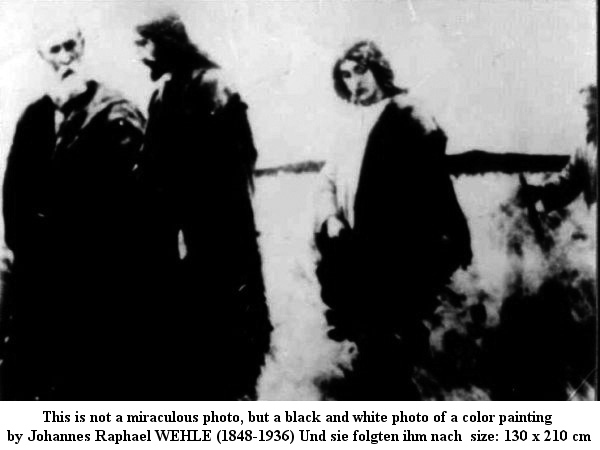
photo of a painting

Is this a miraculous photo?

No, it is a photo of this painting:

The image appears to be of four persons. From left to right:

1. this man looks much older than Jesus, so he is not one of the Apostles.
Joseph of Arimathea is a possibility. Nicodemus is another possibility.

2. Jesus

3. this person has no beard, so it is not a man; a youth might not have a beard, so it could be John the Apostle and Gospel writer.

But this figure appears to be a woman. She is shorter and more delicate, her clothing is different, her eyes are cast down. It is not Mary. It could be Mary Magdalene, and her downcast eyes would represent her sorrow at her sins.

4. possibly Judas Iscariot; the staff in his hand could be figurative for a ‘rod of correction’; then there is the contrast between the rod of Aaron and the rods of the Pharaoh’s magicians in Exodus:

{7:12} And each one cast down their staffs, and they were turned into serpents. But the staff of Aaron devoured their staffs.

So a staff can have the negative meaning of a serpent (the devil).

The fact that the fourth figure is only partly in the photo also seems to be a negative connotation. Judas Iscariot was only partly following Jesus, that is why, in the end, he fell away completely.

Posted in Uncategorized | Comments Off on photo of a painting