This article is a continuation of my previous posts on this topic, especially: Has Iran Begun A Covert Nuclear Breakout? and Iran’s Evolving Breakout Potential: How Bad Is It?
The ISIS Report of 8 Oct 2012 concludes that Iran could make enough Weapon-Grade Uranium metal (25 kg) for one nuclear bomb, in the following scenario:
1) 190 kg of 20% U-235 gas in stockpile
2) ~ 1 month is spent reconfiguring the centrifuges at Natanz to the more efficient tandem cascades, and completing the installation of the additional tandem cascades at Fordo
3) 0.4 months of running the centrifuges, with Natanz purifying 20% uranium to 60% purity, and Fordo completing the process to bring the gas to 90+% purity
Zero point four months (0.4) — that is not a typo — in addition to the one month to set up the centrifuges. So basically, once Iran reconfigures its centrifuges, it takes just 12 days for a nuclear breakout.
As of August, Iran had already purified 189.4 kg of 20% U-235. Some of that U-235 was (supposedly) blended down or converted to uranium oxide — basically made impractical for further purification to make 90% U-235. The remainder is taken by ISIS to be 91 kg plus 25 kg (20% U-235 scheduled to be converted to the unusable form) for a total of 116 kg.
However, these figures are based on August 2012 data. The 30 Aug 2012 ISIS Report states that Natanz and Fordo together produce “14.8 kilograms per month of 19.75 percent LEU”. So September and October add 29.6 kg of 20% uranium gas to the 116, for a total of 145.6 kg. At that rate, Iran will reach 190 kg of 20% uranium in January, 2013.
In the meantime, Iran could reconfigure its centrifuges to tandem cascades. Doing so is not a violation of the NPT (nuclear Non-Proliferation Treaty). It is simply a more efficient configuration. The working centrifuges at Fordo are already in the tandem configuration (ISIS 8 Oct 2012).
It is unlikely that Israel or the U.S. would undertake a military strike in reaction to such a reconfiguration. Any military strike by Israel and/or the U.S. includes the possibility of Iranian retaliation against U.S. bases and against Israel, and the possibility of Muslim outrage that would unite the Muslim nations behind Iran. A strike would also send oil prices skyrocketing. And Iran may attempt to close the strait of Hormuz, provoking further military conflict. The President cannot say to the American people that he ordered the strike because Iran reconfigured its centrifuges to the more efficient tandem configuration. It is not politically viable.
The above is my take on the ISIS worst case scenario. Now let’s discuss my Worst Case Scenario for Iran’s nuclear program.
1. As of 30 Aug 2012, Iran had produced a total of 189.4 kg of 20% U-235.
Iran claims and the IAEA has verified that 96.3 kg of that total has been converted to a form that makes it unusable for subsequent purification into 90% U-235. This would leave 91.4 kg of 20% U-235 gas available for later conversion to 90% U-235 for a bomb.
This claim is not believable. Iran has spent many years and billions of dollars attempting to make a nuclear bomb. They have endured increasingly harsh economic sanctions. They have lived under the threat of a military strike by Israel or the U.S. It is simply unthinkable that they would take more than half of their stockpile of U-235 and convert it to a form that makes it unusable for a nuclear weapon.
So here is what I believe happened to most of that 96 kg of U-235. Iran moved it to a third uranium gas enrichment facility, one that is covert. How can this be, if the IAEA verified that most of the gas was made into uranium oxide metal? It is not difficult for a nation like Iran to deceive a small number of IAEA inspectors. Iran has vast resources, and the inspectors have limited resources. Iran has access to their uranium facilities 24/7, but the inspectors only show up intermittently, typically inspecting about twice a month. Iran can obtain the cooperation of all persons working at any facility and in government at any level. If Iran wants to find a way to deceive the IAEA inspectors, they can do so. And Iran has publicly admitted that they use a strategy of deception regarding their nuclear program (Algemeiner.com). Verify, but don’t trust.
Iran could obtain some uranium oxide metal from China, and show it to the inspectors as if they had turned the gas into metal. They could take some of the gas and feed it into the system for making the metal. Or they could use some other, more complex method of deception. The inspectors do not stand by and watch the entire lengthy process of turning 71 kg or so of gas into metal. But the unstated assumption that Iran has not attempted to deceive the IAEA inspectors, and would be unable to do so if they tried, is absurd.
Therefore, I suggest that Iran may have 71 kg or so of 20% U-235 that is still available for conversion to 90% U-235.
I should also point out that as of August 2012 at least 25 kg of this gas, scheduled for conversion to oxide, was still in gas form. This is the reason that ISIS considered a scenario in which 25 kg of 20% U-235 gas was added to the 91 kg that remained (for a total of 116 kg of 20% U-235).
Adding the 71 kg to the 116 kg of U-235 gives us 187 kg of 20% U-235 gas available for conversion to WGU. But those numbers are as of August 2012. ISIS calculates that Iran produces additional 20% U-235 at a rate of about 14.8 kg per month. This results in the following increase in Iran’s stockpile of 20% U-235 —
187.0 August
201.8 September
216.6 October
231.4 November
246.2 December
261.0 January
Recall that 190 to 200 kg of 20% U-235 is needed for a nuclear breakout in the ISIS worst case scenario. If Iran deceived inspectors and did not convert half of its 20% stockpile to an oxide, then they have about 71 kg more 20% U-235 than the world realizes. That means that Iran already has enough 20% U-235 for a breakout, while the world believes that they are months away from that point.
2. All of the breakout scenarios considered in the recent ISIS Report have Iran using Natanz or Fordo or both for the production of 90% U-235. ISIS says:
“Although Iran’s breakout times are shortening, an Iranian breakout in the next year could not escape detection by the IAEA or the United States. Furthermore, the United States and its allies maintain the ability to respond forcefully to any Iranian decision to break out. During the next year or so, breakout times at Natanz and Fordow appear long enough to make an Iranian decision to break out risky….
“Nonetheless, Iran’s current trajectory at Fordow is increasing the chance of a military confrontation, particularly given growing concern about the relatively short breakout time at this facility once the plant is fully operational and once Iran has accumulated significantly more near 20 percent LEU hexafluoride.”
Iran knows 3 things about the above discussed situation. (1) Any breakout using Natanz or Fordo will be detected, prompting a military strike. (2) But if Iran continues to accumulate more 20% U-235 gas, the breakout time becomes ever shorter, eventually prompting a military strike even without a breakout attempt. (3) Iran must obtain a nuclear weapon before either of the aforementioned points prompt a military strike. How can they accomplish this? Only by means of a covert breakout.
3. Iran wanted a covert uranium gas enrichment facility.
So, at great expense, they built one under the side of a mountain in a remote location. But that location, Fordo near Qom, was discovered by Western intelligence agencies. According to Benjamin Netanyahu, in his speech to the U.N. (27 Sept 2012), it was discovered only after more than 2 years. See my previous article on this point.
Once Fordo (Qom) was discovered, Iran must have wanted a new facility, one that would remain covert. In fact, a covert breakout is their only viable option. They NEED a covert facility and they know it. They have the money and the means and the desire. What has prevented Iran from building a third uranium enrichment facility? Nothing. Therefore, it is reasonable to conclude that they have already built such a facility.
Reza Kahlili, former CIA operative within the Iranian Revolutionary Guard, has disclosed his understanding, based on various sources, that the third facility exists at Najafabad, near the major Iranian city of Isfahan. He explains that the site,
“which was built with a capacity of 800 centrifuges for uranium enrichment, has been up and running for some time and currently is enriching uranium to weapons grade for the nuclear bomb project.”
I don’t know if the site mentioned by Kahlili is the third covert facility, but I am certain that Iran must have such a facility somewhere. Iran needs such a site, since a non-covert breakout would prompt a military strike. The Isfahan site is apparently near the site where the 71 kg of 20% U-235 was supposedly turned into an oxide. Moreover, the site is in a direct line along a major highway to Natanz, and then straight on to Qom.
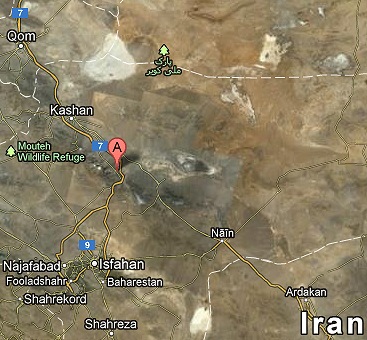
The ‘A’ on the map above is Natanz, and you can see Qom above it, and Isfahan below it. This geographic arrangement is useful to Iran. These three locations are far from the Persian Gulf, where the U.S. has ships, and also far from the Black Sea to the North. It is far from the border of Iran with Afghanistan and Pakistan, where the U.S. has troops. And it is far enough from the border with Iraq, where the U.S. formerly had troops. These three locations are on a major highway, so it is harder for satellites to keep track of trucks going to and from and between those locations. And these locations are near enough to a major city (Isfahan) that would have the infrastructure for building large facilities, whether above or below ground. So the Najafabad location, near Isfahan, makes sense; it fits with the choices Iran made for the other two locations.
4. The third facility at Isfahan is smaller than Qom and much smaller than Natanz. Kahlili says that it holds only 800 centrifuges. If these were the IR-1 generation centrifuges, then it would take too long to enrich enough 90% U-235 for what ISIS calls 1 Significant Quantity (enough 90% gas for 25 kg of WGU metal). But Iran has IR-2m and IR-4 next generation centrifuges, which are much more efficient. ISIS says:
“Yet, there is another possibility. Iran could deploy advanced centrifuges at the Fordow enrichment plant or possibly at a third enrichment site. Its advanced centrifuges, principally the IR-2m and perhaps the IR-4 models, are expected to achieve about 3-4 times the enrichment output of the IR-1 centrifuges. Iran is currently testing both types in production-scale cascades at the Natanz Pilot Fuel Enrichment Plant but making progress at a much slower rate than expected. However, with advanced centrifuges, Iran could increase by several-fold its production of 19.75 percent LEU and it could break out with far fewer (less than 1,000) machines. For this reason, any deployment of advanced centrifuges will inevitably increase tensions.”
The IR-2m centrifuges have been up and running at Natanz for some time now, and yet they are “making progress at a much slower rate than expected.” Iran has plenty of experience building and running thousands of IR-1 centrifuges; they have over 10,000 in operation as of August 2012. So it is possible that Iran is “sandbagging”, making it seem as if they are having much trouble getting the IR-2m centrifuges to work, when in fact they work well. Why would Iran engage in such a deception? So that no one would wonder, if these centrifuges are so much more efficient, with “3-4 times the enrichment output of the IR-1 centrifuges,” then why have they not been installed and put into service?
The reason is perhaps that these IR-2m centrifuges work well, and have been installed in the third covert facility (perhaps located near Isfahan). A facility with 800 IR-2m centrifuges would have the enrichment output of 2,400 to 3,200 IR-1 centrifuges. This would give the third facility a breakout time of only a few months, given a sufficient stock of 20% U-235.
The Fordo facility, as of August 2012, had 4 cascades of 174 centrifuges each (696 total). There are 8 additional cascades partially installed, comprising 1392 additional centrifuges, for a total of 1566. But the IR-2m centrifuges are 3 to 4 times more efficient. So, for a covert facility to have the same production capacity as Fordo will have once the additional centrifuges are working, it would need only 4 cascades (2 pairs of cascades in tandem) — 696 centrifuges. The small facility that Kahlili claims is the third covert location is large enough for that number of cascades.
ISIS estimates that a breakout at Fordo alone, at full capacity, would take 200 to 220 kg of 20% U-235 (stockpiled) and 2.0 to 2.2 months. Since a small covert facility with IR-2m units would have the same capacity as the fully-operational Fordo facility, a covert breakout in this scenario would take about the same amount of 20% U-235 and about the same amount of time.
But even if we assume that the covert facility has only 696 of the IR-1 units, a covert breakout is still possible. It would merely take 3 times longer: 6.0 to 6.6 months. This length of time for a breakout is entirely viable, if it is covert.
If such a covert facility exists, then the 71 plus 25 kg of 20% U-235 that was supposedly converted, or scheduled for conversion, to oxide may well have been already converted into 90% U-235 gas. Iran may already be about halfway to 1 SQ.
5. According to ISIS, 25 kg of WGU metal is enough for one nuclear bomb. However, some experts put the minimum amount of WGU for a nuke much lower, in the range of 4 to 9 kg of WGU per bomb, for a low yield, with medium expertise:
The IAEA considers 25 kg of U-235 to be one ‘significant quantity,’ i.e., a bomb’s worth, but as Cochran and Paine have explained, and as Dalnoki-Veress, Lewis, and Pomper have already discussed extensively, this figure is much too high in almost all contexts…. But to make a long story short, Cochran and Paine estimate that a relatively low-tech bomb program would need between 8 and 16 kg of U-235 for a pure fission weapon (an ‘A-bomb’), depending on how much explosive yield is desired. A medium-tech program, which is perhaps where Iran fits thanks in part to the foreign assistance described in GOV/2011/65 [the Nov 2011 IAEA Report], would need between 4 and 9 kg of U-235.” (ArmsControlWonk.com)
So the 25 kg of WGU that Iran could make in 1.3 to 1.4 months under one of the worst case scenarios offered by ISIS is enough WGU for 2 to 4 nuclear bombs. A breakout to one SQ (significant quantity, i.e. 25 kg) is actually enough for a few nuclear bombs.
Corroboration
Much of the above worst case scenario is conjecture. Iran may have a 3rd enrichment facility, and it may be at Isfahan. That facility may use the newer and more efficient IR-2m centrifuges, instead of the IR-1. Or the covert breakout will simply take longer. Iran may have deceived the IAEA by obtaining uranium oxide from China, so that the 71 kg of 20% U-235 was not converted to an unusable oxide, but into 90% WGU. Iran may be currently in the process of a covert nuclear breakout.
Is there any way to prove that this is the case? Short of Iran announcing they have nukes, or testing one in an underground facility, or using one on the U.S. or Israel, there is no proof. But Iran’s next move may corroborate my worst case scenario. If Iran is currently in the midst of a covert breakout, they will need some excuse to move the all of the remaining 20% U-235 gas to the covert facility. Iran will need to make some type of plausible claim that will allow them to move the gas, without raising suspicions.
So, if in the next month or two, Iran announces some major change to its enrichment operations, one that would allow Iran to take the current stockpile of 20% U-235 gas out from under the watchfulness of the IAEA inspectors, that event would corroborate the above scenario.
by
Ronald L. Conte Jr.
Roman Catholic theologian and
translator of the Catholic Public Domain Version of the Bible.