
In order to understand the latest IAEA report on Iran’s nuclear program, due out tomorrow (Friday, 16 Nov 2012), you need to understand certain basic concepts, which I will summarize below.
Iran has been enriching uranium, supposedly for peaceful purposes, for many years. Uranium purification takes natural uranium ore, turns it into a gas (uranium hexafluoride: one uranium atom with six fluoride atoms). Most of the gas molecules will contain the common uranium isotope U-238, so called because the total number of protons and neutrons is 238. A small percent (~0.7%) will be U-235, which has 3 fewer neutrons. U-235 is the type of uranium used in nuclear reactors, used to made medical isotopes, and — if enriched to greater than 90% purity — used to make a nuclear bomb.
The uranium hexafluoride gas is run through a centrifuge that spins at supersonic speeds (literally faster than the speed of sound). The U-235 gas is only slightly lighter than the U-238 gas, but the centrifuges are efficient enough to concentrate that lighter gas toward the center of the machine, where it is drawn off and piped to the next centrifuge, and the next, one after another. At each step, the gas will have a slightly higher percent of the lighter U-235 gas.
We know from past IAEA reports that Iran’s nuclear enrichment program uses 174 centrifuges, connected in a series, to purify the uranium gas. Each set of 174 centrifuges is called a cascade. The cascades can be arranged in single or in tandem. The tandem arrangement connects two cascades, for a more efficient, but somewhat slower purification.
The process used by Iran starts with natural uranium metal converted to uranium hexafluoride gas, and, as a first step, [1] purifies it from 0.7% to 3.5% U-235. The second step [2] purifies the gas from 3.5% to just under 20% U-235. If Iran wanted to make Weapon-Grade Uranium (WGU), they would need to enrich the uranium gas through two more steps: [3] from 20% to 60%, and then [4] from 60% to 90+% U-235.
Once the gas reaches over 90% U-235 purity, it can be converted from gas to uranium metal. The metal is then machined to make a hollow sphere, which is the most difficult component of a nuclear bomb to obtain. According to the IAEA report of 8 November 2011, Iran already has all of the other components need to make a nuclear bomb, other than enough WGU.
Iran has two known uranium enrichment facilities: Natanz and Fordow (near Qom). Natanz is used mainly to purify uranium to 3.5%, and Fordow is used exclusively to purify 3.5% uranium to near 20%. It takes very many centrifuges to purify natural uranium to 3.5%, so Natanz is a much larger facility than Fordow. Natanz has over 9,000 centrifuges, which is over 50 cascades (174 centrifuges per cascade). These are arranged as less efficient but faster single cascades. By comparison, Fordow, a small underground facility, has room for only 16 cascades, which is 2,784 centrifuges. These have so far been arranged as the more efficient tandem cascades, that is, as 8 pairs of cascades with 348 centrifuges per tandem. In the last IAEA Report (Aug 2012), Fordow had only 4 cascades (2 tandems), totally 696 centrifuges, in operation.
As far as we know, Iran has not yet purified U-235 gas to 60% or to 90+%. I say, as far as we know, because Iran may have a third secret uranium enrichment facility. The Fordow facility was originally secret. It was built a few hundred feet under solid rock, in the side of a mountain. This type of construction is difficult and expensive. Iran obviously intended to keep that facility secret, but it was discovered by Western intelligence operatives. Iran wanted, and probably still wants, a secret enrichment facility. They have the money and means to make such a facility, so it stands to reason that, in all likelihood, they have built (or are in the process of building) a third secret facility for the enrichment of WGU. See my previous post: Has Iran Begun A Covert Nuclear Breakout?
The 8 October ISIS report, Iran’s Evolving Breakout Potential, by Witt, Walrond, Albright, and Wood, examined various potential scenarios, under which Iran might rush to make enough 90% U-235 gas for at least one nuclear bomb. This type of rush to make WGU is called a breakout. At that point in time, Iran can no longer credibly claim to be enriching uranium for peaceful purposes.
The ISIS analysis considers that Iran would use either or both known facilities, Natanz and/or Fordow, to make WGU in a nuclear breakout. The report briefly considered the possibility that Iran might breakout using a third facility and fewer but more advanced centrifuges:
“Yet, there is another possibility. Iran could deploy advanced centrifuges at the Fordow enrichment plant or possibly at a third enrichment site. Its advanced centrifuges, principally the IR-2m and perhaps the IR-4 models, are expected to achieve about 3-4 times the enrichment output of the IR-1 centrifuges. Iran is currently testing both types in production-scale cascades at the Natanz Pilot Fuel Enrichment Plant but making progress at a much slower rate than expected. However, with advanced centrifuges, Iran could increase by several-fold its production of 19.75 percent LEU and it could break out with far fewer (less than 1,000) machines. For this reason, any deployment of advanced centrifuges will inevitably increase tensions.” (8 Oct 2012 ISIS report, p. 21)
I consider that possibility to be the more likely one. Any non-covert breakout runs the risk of a military strike by the U.S. or Israel.
But the main analysis offered by ISIS of a possible breakout would use the Natanz and/or the Fordow facilities. To summarize, the fastest and most practical breakout by Iran would use Natanz centrifuges in single cascades to purify an existing stockpile of 20% U-235 gas to 60%. And then the Fordow facility, once it is at full capacity, would use tandem cascades to purify the 60% U-235 gas to 90+%. Then the gas would be moved off-site, to protect it from a military strike.
The total time for this breakout would be 0.8 to 1.0 months, which is 24 to 30 days. About half a month (0.5) would be needed to set up the centrifuges, and the rest of the 0.8 to 1.0 months (another 0.3 to 0.5 months) would be used to enrich the gas. See Table 8 below, taken from p. 18 of the 8 Oct. 2012 ISIS Report.
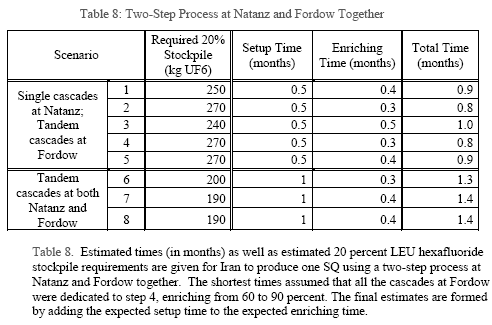
In order to begin this “one month or less” nuclear breakout, Iran needs certain resources in place. They need to have all of the 2,784 centrifuges at Fordow operational and arranged in the tandem configuration. The Natanz centrifuges can be left in their current single cascade arrangement. Then they need 240 to 270 kilograms of U-235 gas. Their current stockpile of 20% U-235 is the subject of some speculation. The IAEA Report due out tomorrow (16 Nov 2012) should shed some light on that number. The current estimate is that Iran will have enough 20% U-235 gas for a break out by late 2012 or early 2013.
Another issue is the claimed conversion of a large portion of Iran’s U-235 gas into an oxide, a form that cannot readily be used to make nuclear weapons. As of 30 Aug 2012, Iran had produced a total of 189.4 kg of 20% U-235. Iran claims and the IAEA has verified that 96.3 kg of that total has been converted to an oxide, a form that makes it unusable for subsequent purification into 90% U-235. This would leave 91.4 kg of 20% U-235 gas available for later conversion to 90% U-235 for a bomb (plus whatever 20% U-235 has been produced since the August IAEA report).
This claim is not believable. Iran has spent many years and billions of dollars attempting to make a nuclear bomb. They have endured increasingly harsh economic sanctions. They have lived under the threat of a military strike by Israel or the U.S. It is simply unthinkable that they would take more than half of their stockpile of U-235 and convert it to a form that makes it unusable for a nuclear weapon.
So I believe that Iran moved most of that 96 kg of U-235 to a third uranium gas enrichment facility, one that is covert. How can this be, if the IAEA verified that most of the gas was made into uranium oxide metal? It is not difficult for a nation like Iran to deceive a small number of IAEA inspectors. Iran has vast resources, and the inspectors have limited resources. Iran has access to their uranium facilities 24/7, but the inspectors only show up intermittently, typically inspecting about twice a month. Iran could obtain some uranium oxide metal from China, and show it to the inspectors as if they had turned the gas into metal. They could take some of the gas and feed it into the system for making the metal. Or they could use some other, more complex method of deception. The inspectors do not stand by and watch the entire lengthy process of turning 96 kg or so of gas into metal. Therefore, I suggest that Iran may possess significantly more 20% U-235 than the IAEA and most governments believe that Iran possesses.
The 8 Oct 2012 ISIS report actually takes this possibility into account, to some extent (page 7 and following). They consider that Iran might remove up to 25 kg of the 96 kg of gas that was moved to a facility for conversion to oxide form, and might add those 25 kg to the rest of their stockpile of 20% U-235 gas.
The next IAEA Report on Iran comes out tomorrow (Friday, 11/16/2012). Some press reports quote unnamed diplomats as saying that the installation of the full complement of 2,784 centrifuges at Fordow is nearly complete. This is the first of two preconditions needed for a nuclear breakout. The other is a stockpile of 20% U-235 gas of 240 to 270 kilograms. It will be interesting to see, from tomorrow’s Report, how close Iran is to both of those preconditions. Once Iran achieves both, a nuclear breakout will take one month or less. But again I remind the reader that, if Iran has a third covert facility, a covert breakout may already be underway.
by
Ronald L. Conte Jr.
Roman Catholic theologian and
translator of the Catholic Public Domain Version of the Bible.



 the reproach of Christ